TL;DR
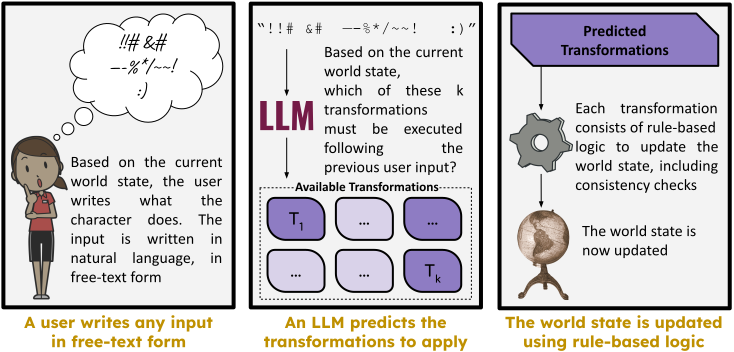
PAYADOR explores how LLMs can be grounded on structured data to increase the consistency of the fictional world-state after a user input. The system models the fictional world as components (items, characters, locations, and puzzles) and uses LLMs to predict (already pre-programmed) world-state Transformations that modify that state.
How it Works
Transformations
LLMs predict Transformations—changes to the symbolic state of the world that are applied to the structured world model.
World Model
Items, Puzzles, Locations, and Characters model the fictional world state.
Consistency Checks
Structured world data enables consistency checks against basic integrity constraints (e.g., preventing movement to unreachable locations), preventing logically invalid LLM-suggested transformations.
Free-text Input
The system processes free-text player input and maps it to transformations applied to the structured world-state model.
Language Extensibility
Supports Spanish and English. The modular architecture makes extending to additional languages straightforward with minimal effort.
Publications
PAYADOR was first proposed in the ICCC'24 paper and further developed in Santiago Góngora's Master's thesis. The ICCC'26 paper presents a pilot study on the system's performance.
Featured In
Les Réseaux de Personnages: Nouveaux Outils d'Analyse
Coline Métrailler's research on computational analysis of character relationships and social structures in narratives cites PAYADOR as an example of modern Interactive Storytelling using LLMs.
Source
Things I Think Are Awesome (TITAA #56)
Lynn Cherny featured PAYADOR in her June 2024 newsletter on computational creativity and LLM interfaces, discussing how it grounds language models in structured world data for interactive storytelling.
Source
It’s Gonna Be Different Every Time (hob.farm)
HOBFARM featured PAYADOR in a blog post, highlighting its use of world-state transformations to address consistency problems in purely LLM-based interactive storytelling systems.
Source
The Wizard in the Town Plaza
This ICCC'25 Best Poster award-winning paper explores voice-based interactive storytelling in public spaces and cites PAYADOR as a relevant approach for grounding language models in structured world-state data.
Source
IVIE: Generación incremental y validada de mundos jugables para experiencias interactivas
Micaela Vaucher & Santiago Silveira propose a system for generating interactive fiction worlds, using PAYADOR as the underlying framework for its world-state management and transformation prediction.
Source
Computational Tools for Table-Top Role-Playing Games: A Scoping Review
Fiona Shyne & Seth Cooper's scoping review of computational tools in TTRPGs research cites PAYADOR as an example of a Game Mastering model for table-top role-playing games.
Source
Getting Started
For detailed documentation, visit the repository on GitHub.